Home · The Brotherly Kiss
The Brotherly Kiss
A 1990 painting by Dmitri Vrubel on the Berlin Wall showing Soviet leader Leonid Brezhnev and East German leader Erich Honecker in a “socialist fraternal kiss.” Its full title is “My God, Help Me to Survive This Deadly Love.”
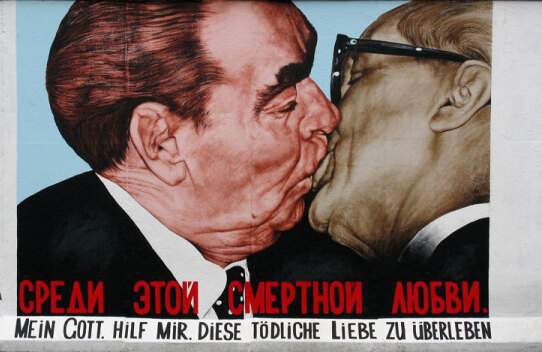
The Brotherly Kiss on the East Side Gallery today (2009 version)
What it is
In 1990, on the eastern side of the Berlin Wall — the stretch that became the open-air East Side Gallery — Dmitri Vrubel painted two men kissing on the lips: Leonid Brezhnev and Erich Honecker. He gave the work the title “My God, Help Me to Survive This Deadly Love” (German: Mein Gott, hilf mir, diese tödliche Liebe zu überleben). Around the world it is better known simply as The Brotherly Kiss, the Fraternal Kiss, or the Bruderkuss.
Who is depicted, and why they are kissing
The two figures are real political leaders, shown performing the socialist fraternal kiss — a ritual greeting between allied communist leaders. It was a genuine gesture of the era, not an invention of the artist.
The photograph behind the painting
Vrubel based the image on a photograph taken on 7 October 1979 by Régis Bossu, during Brezhnev’s visit to East Berlin for the 30th anniversary of the GDR. The painting is Vrubel’s work; the underlying moment was a real, widely published news photograph. (We credit Bossu as the photographer of the source image; we do not reproduce his photograph here.)
“It was a repulsive, disgusting thing — at first it almost made me sick. But all the same, I wanted to capture in art what cannot be captured there, and the work somehow began to live a life of its own in my head.”
— Dmitri Vrubel, on the photograph that became the painting
The meaning of the title
Beneath the two men Vrubel painted the line “My God, help me to survive this deadly love.” The phrase reflects both the political subject and the atmosphere of the era in which the work was made.
How it was created (1990)
The mural was made in the months after the Wall opened, as more than a hundred artists from around the world painted the surviving eastern side into what became the East Side Gallery.
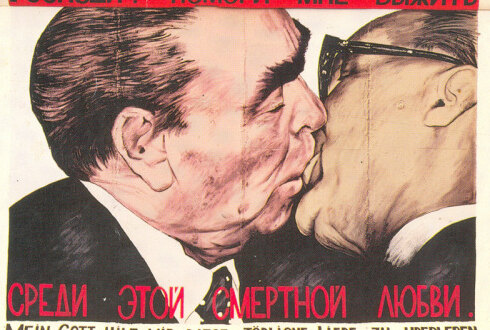
The 2009 version
By the late 2000s the original 1990 painting had badly deteriorated. During the major 2009 restoration of the East Side Gallery the panel was renewed and Vrubel repainted the work himself — the image visitors see today is his own later version of his own painting.
The work today
The Brotherly Kiss stands on the East Side Gallery, Mühlenstraße, Berlin-Friedrichshain, on the longest surviving stretch of the Berlin Wall — a protected monument in the care of the Stiftung Berliner Mauer (Berlin Wall Foundation).
An icon in 10 facts
How one painting on the Berlin Wall became a global cultural image.
Dmitri Vrubel painted the work on the Berlin Wall in 1990. Its full title is “My God, Help Me to Survive This Deadly Love.”
The composition originates from the photograph of Brezhnev and Honecker taken by French photographer Régis Bossu during the GDR’s 30th-anniversary celebrations. We credit Bossu; we do not reproduce his photograph.
The gallery runs for approximately 1.3 kilometres along a surviving stretch of the Berlin Wall — the longest remaining section.
The open-air gallery is commonly described as the work of around 118 artists who painted its eastern side after the Wall opened.
According to the Berlin monument authority, the East Side Gallery’s artists came from 21 different countries.
Contemporary German media report approximately four million visitors to the East Side Gallery each year, among Berlin’s most-visited sights.
German media repeatedly describe The Brotherly Kiss as among the most photographed works at the East Side Gallery.
During the 2009 restoration the deteriorated earlier mural was removed, and Vrubel returned to paint the image again himself. Today’s mural is a second authorial version by Vrubel — not a reconstruction by another hand.
During the 2009 repainting, Der Tagesspiegel reported that the East Side Gallery had received more than 45 press enquiries from around the world.
The image moved far beyond its physical location, becoming widely reproduced and reinterpreted across popular culture and visual media.
Sources: Berlin monument authority — East Side Gallery (21 countries; 1.3 km); Der Tagesspiegel, 17 June 2009 (the 2009 authorial repainting; “more than 45 press enquiries”); contemporary German media (≈4 million visitors a year; 118 artists commonly cited). Full references on the Press & Voices page.