Dmitri VrubelEstate of Dmitri Vrubel · 1960–2022

Home · On Dmitri Vrubel

Voices & reception

On Dmitri Vrubel

Artists, critics, poets, political figures and voices from popular culture on Dmitri Vrubel and the images that entered collective memory.

A living archive of interpretations, memories and historical testimony. Public sources and materials held by the Estate are presented with their provenance.

Dmitri Vrubel
Dmitri Vrubel · 1960–2022
Documented voices

Artists, critics & contemporaries

Critical interpretation

Boris Groys

philosopher and art theorist
“Vrubel and Timofeeva’s works perfectly illustrate this structure of contemporary belief.”

Writing on the Gospel Project, Groys reads its collision of Gospel text and international news imagery as a reflection on modern belief in the newness of news itself.

Kandinsky Prize archive →
Curatorial assessment

Marat Guelman

gallerist and curator
“These are all the best artists in the country.”

His gallery worked with Vrubel from the 1990s; he later curated the Gospel Project at PERMM.

Archive →
Historical testimony

Dmitri Prigov

poet and conceptual artist
“Dmitri Vladimirovich, this would be good to paint on the Berlin Wall.”

Vrubel recalled Prigov seeing the early Brezhnev–Honecker sketches in Moscow and making the suggestion.

Interview →
Personal testimony

Vladimir Dudchenko

art critic and collector
“a contemporary legend”

His remembrance traces Vrubel from news-feed imagery through the Gospel Project, Tolstoyevsky and VR.

Art Focus Now →
Institutional assessment

PANDA platforma

Berlin cultural institution
“one of the most important Berlin artists of the 21st century”

PANDA’s memorial text documents Vrubel and Timofeeva’s Open Studio, Tolstoyevsky and their virtual exhibitions — a record of Vrubel’s later Berlin period beyond the Wall.

PANDA platforma →
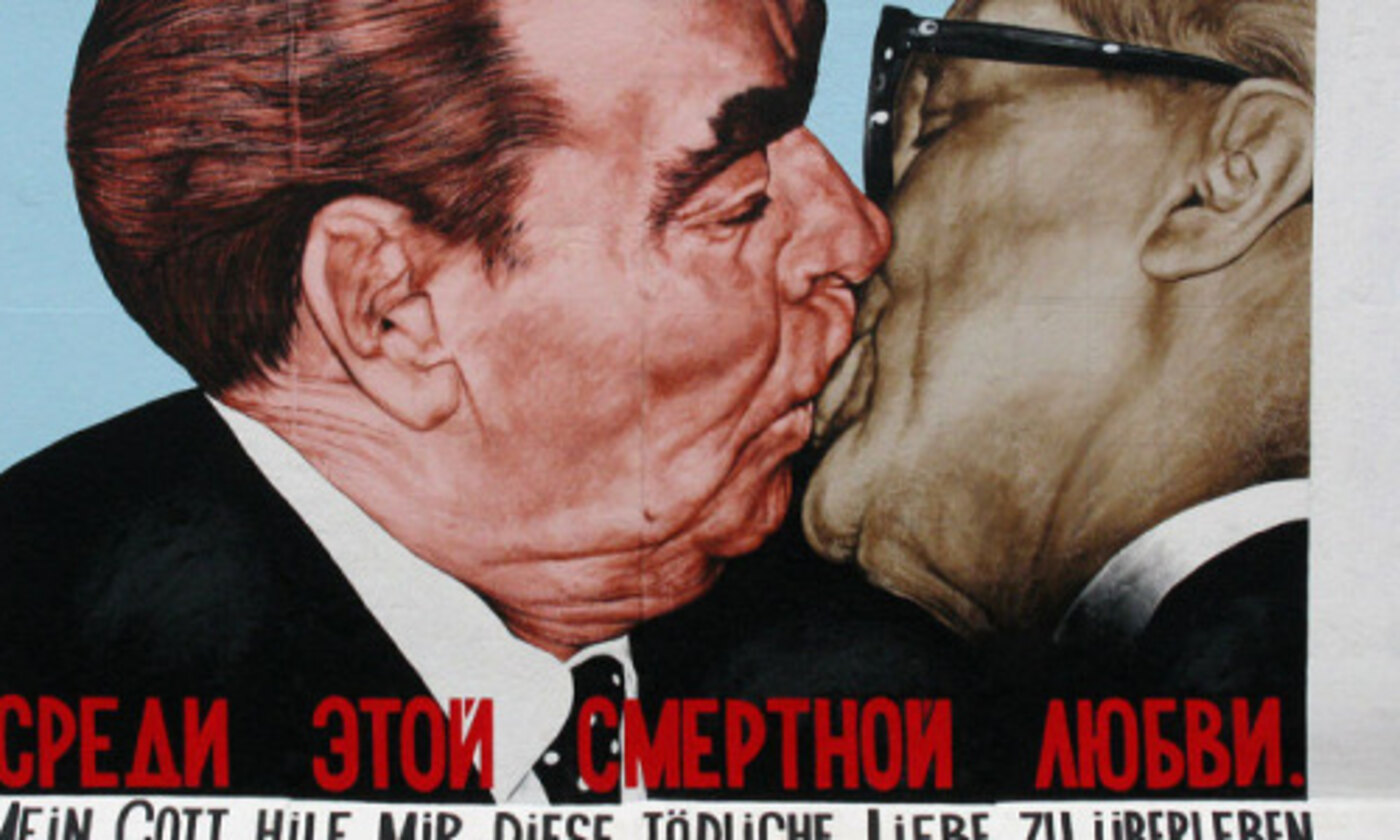
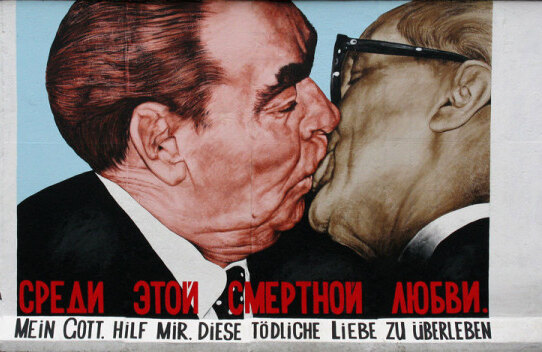
The Brotherly Kiss
The Brotherly Kiss · Berlin Wall / East Side Gallery
“An image can leave its original moment and become part of how history remembers itself.”
Estate archive

Voices across culture and history

The following quotations are published from documentation held by the Estate.

01

Art historians & curators

media artist, theorist and curatorPeter Weibel
“Vrubel did what great media art does: he took an official photograph, transferred it onto a wall — and in doing so changed its meaning. What had been a propaganda ritual became an image of the deadly intimacy of power and the individual. His ‘Kiss’ is not graffiti. It is a visual machine of memory.”
Estate archive
curatorHarald Szeemann
“There are artists who decorate history, and there are those who make it visible. Vrubel chose the wall — the hardest material of the twentieth century — and turned it into a surface of human tragicomedy. His ‘Brotherly Kiss’ belongs neither to Berlin nor to Moscow: it belongs to the world.”
Estate archive
writer and art criticJohn Berger
“We are used to thinking that we see a photograph. But Vrubel shows that an image always depends on where and by whom it is seen. In the official photograph — an alliance. On the Berlin Wall — the suffocating love of an empire. The artist did not change the leaders’ faces; he changed the conditions of looking.”
Estate archive
artistIlya Kabakov
“Dmitri understood the essential thing: Soviet life lived not only through fear, but through a compulsory language of love — brotherly, popular, state-sanctioned. He took that language literally, pushed it to absurdity — and in that absurdity the truth appeared. His ‘Kiss’ is funny and frightening at once, like our era itself.”
Estate archive
The Brotherly Kiss · East Side Gallery
02

Politics & history

statesmanMikhail Gorbachev
“Vrubel created an image that outlived both the Soviet Union and the Berlin Wall. This kiss contains the whole duality of our era: we spoke of brotherhood, while people were divided by a wall. The artist reminded the world that behind great political words there are always living people.”
Estate archive
statesmanHelmut Kohl
“The Berlin Wall was not simply concrete. It was a system of fear. Vrubel managed to reveal its human dimension — and that is why his work became part of the history of German reunification. Art can sometimes speak about freedom more precisely than diplomacy.”
Estate archive
poet and essayistJoseph Brodsky
“Empire always speaks of love, because love is the most convenient word for coercion. Vrubel understood this. His ‘Kiss’ is not a satire on two men, but a portrait of an entire civilisation that demanded tenderness by order. That is why it is so frightening and so exact.”
Estate archive
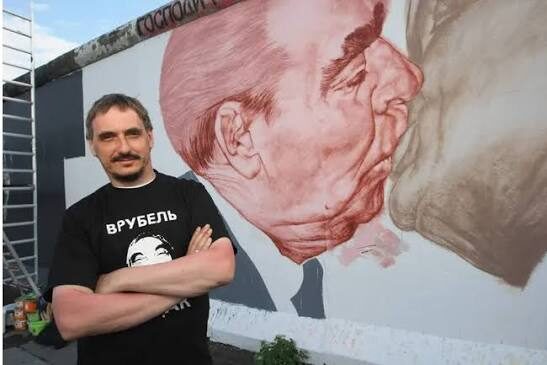
Dmitri Vrubel
Dmitri Vrubel
03

Rock & pop culture

musicianDavid Bowie
“I sang about people kissing by the Wall as if nothing could fall. Vrubel did the opposite: he showed leaders kissing as if the Wall itself had to collapse from that love. Both images are about Berlin. But his is more frightening and more honest.”
Estate archive
musicianLou Reed
“Berlin has always been a city where beauty lives beside brutality. Vrubel knew that. His ‘Kiss’ is not a pretty picture for tourists. It is rock and roll: dirty, political, funny and deadly serious.”
Estate archive
musicianMichael Jackson
“Some images become music for the eyes: they are recognised instantly, in any country, without translation. Vrubel created exactly such an image. He turned a political moment into a universal language — about power, love and human fragility.”
Estate archive
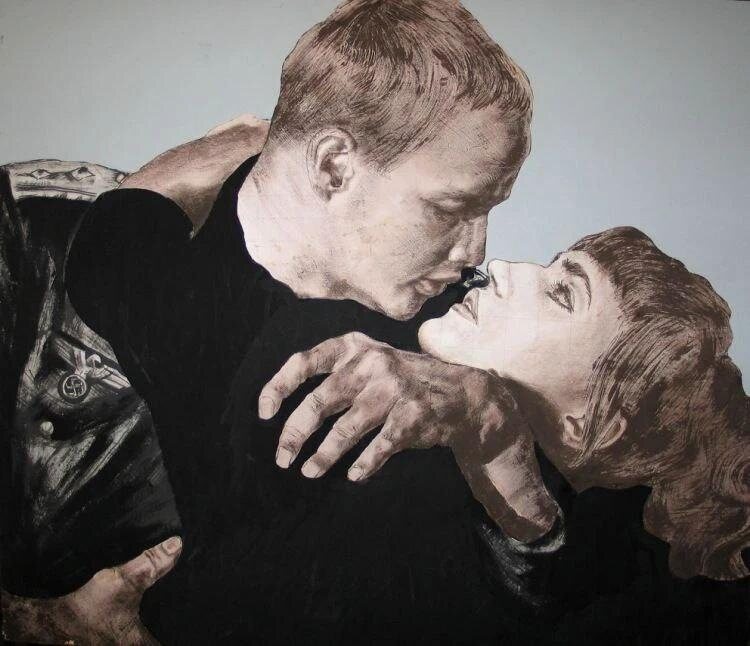
Vika and Marlon Brando
04

Film & acting

filmmakerDavid Lynch
“There is something almost nightmarish in this kiss. Two faces, too close. Smiles that do not reach the eyes. A wall behind them. Vrubel understood that the most disturbing things often look like official ritual. His work is like a dream from which you do not immediately realise you have not awakened.”
Estate archive
actorMarlon Brando
“Power likes to speak of brotherhood because brotherhood costs less than freedom. Vrubel showed the price of that language. His ‘Kiss’ is a portrait of people who give orders and call it love.”
Estate archive
Critical reception

Writing on the work

Anna Tolstova · Kommersant

Her 2008 review reads the Gospel Project through its monumental use of press photography, advertising-scale vinyl and Gospel quotations.

Read source →
Kira Dolinina · Kommersant

Her 2022 obituary confronts the paradox of an artist with a much wider body of work being remembered publicly through a single globally famous image.

Read source →
Birgit Rieger · Der Tagesspiegel

The Berlin obituary called Vrubel the “Brotherly Kiss painter and master of the Zeitgeist” and described the mural as a symbol of peace, love and crossing boundaries.

Read source →